HOA HankTHINGS YOU NEED TO KNOW
Launch promo ends in 00:00:00
HOA Hank Ninety Moves For Homeowners

The Board Is Not A Court. The Letter Is Not A Judgment.

Most homeowners lose to their association not because the association is powerful, but because one side has read the paperwork and the other has not. This is the paperwork — the notice, the cure period, the hearing, the ledger, the lien, the election — ninety moves in the order things actually happen, written by someone who read his declaration only after the fine arrived.

Instant download · Yours forever

90Moves
135Pages
7Parts
HOA Hank in his garage

“Underneath all of it is a stack of documents and a state statute, and both of them have limits.”

HOA Hank · Before You Start
Section I · The Book

It Started With A Trailer In My Own Driveway

Two nights, while I was loading it. A fine attached, and a deadline that had already half expired by the time the envelope reached me.

I called. I got a coordinator at a management company two states away who told me the rule was the rule. So I went and read the declaration — the one I had signed for at closing and never opened. The trailer provision said something different from the letter. It allowed exactly what I was doing, for exactly as long as I had been doing it.

Nobody at the association had read it either.

That is the whole thing in one story, and it is why this book exists. The people who lose in these communities are not the ones with the worst boards. They are the ones who argue with the letter instead of reading the document the letter is supposed to be enforcing.

“The board is not a court. The management company is a vendor. The letter is not a judgment.”

The Kill Switch is ninety numbered moves, each one short on purpose. What the thing is, how it actually works, what to do about it — and then The Limits, which is where I tell you where my move stops working and you need your own state statute or your own attorney. Every single move has that section. A guide that never tells you where it ends is not being honest with you.

You can read it straight through once, and I would. But it is built to be opened at the page you need on the day something arrives in the mail. Letter in your hand right now? Part Three. A balance you do not recognise? Part Four, and go quickly — money problems have the shortest fuses in this whole subject.

Section II · The Difference

Same Notice. Two Completely Different Outcomes.

Nothing here is about being louder than your board. It is about arriving with the paragraph, the date, and the receipt.

How most owners handle it The expensive way
  • Argue about it in the neighbourhood group and at the mailbox
  • Ignore the notice because the rule is obviously absurd
  • Answer the letter with how unfair it is
  • Pay the balance to make it go away, then watch the fee stack rebuild
  • Read the declaration after the cure period has already closed
  • Walk into the hearing with a speech and no folder
  • Call an attorney at the point where the bill is bigger than the fine
How the Kill Switch handles it The ninety moves
  • Open the declaration first, then the statute, then the letter
  • Respond inside the deadline every time, even if only to request information
  • Make them show you the provision they say you violated
  • Read the ledger line by line, and pay under protest where it applies
  • Request the fine schedule and the minutes that adopted it
  • Arrive at the hearing with a dated folder and three sentences
  • Do the arithmetic before you escalate anything
Section III · What's Inside

Ninety Moves, Seven Parts, In The Order Things Happen

Every move ends with The Limits — where it stops working, and what is state-specific. This is the complete contents of the First Edition.

Part One · Know What You're Dealing With12 moves
  • 1An HOA Is a Corporation, and You Are a Member of It
  • 2The Hierarchy of Authority, and Why It Wins Arguments
  • 3The Board Is Your Neighbors, Not the Government
  • 4What the Management Company Actually Is
  • 5Mandatory, Voluntary, and the Difference That Matters
  • 6Your Lot, the Common Area, and Everything Between
  • 7Where the Money Goes
  • 8Find Your State Statute Before You Do Anything Else
  • 9Fiduciary Duty and the Business Judgment Rule
  • 10Why Boards Behave the Way They Do
  • 11Most Cases Start With a Neighbor, Not an Inspection
  • 12What Leverage You Actually Have
Part Two · The Documents12 moves
  • 13Get the Complete Set, Not the Handout
  • 14How to Read a Declaration Without Losing an Evening
  • 15Amendments: Make Sure You Have the Current Law
  • 16Bylaws Run the Corporation, Not Your Yard
  • 17Rules and Regulations: The Weakest Tier
  • 18The Rulemaking Clause, Word by Word
  • 19Architectural Guidelines and the Application Form
  • 20The Plat, the Easements, and the Setbacks
  • 21Minutes Are the Most Underrated Document You Own
  • 22Contracts, Vendors, and Where the Dues Really Go
  • 23The Resale Package Tells the Truth
  • 24Build the Binder Before You Need It
Part Three · Violations and Fines15 moves
  • 25Anatomy of a Violation Notice
  • 26Never Ignore It, Even If It Is Absurd
  • 27Make Them Show You the Provision
  • 28The Cure Period and What Curing Actually Means
  • 29Your Right to a Hearing
  • 30How to Prepare for a Hearing
  • 31How to Behave in the Room
  • 32The Written Decision and the Appeal
  • 33Fine Schedules and Where the Authority Comes From
  • 34Daily Fines, Stacking, and Runaway Balances
  • 35Selective Enforcement
  • 36Waiver, Laches, and the Passage of Time
  • 37They Told You It Was Fine: Approval, Estoppel, and Prior Boards
  • 38Suspension of Privileges and Amenity Access
  • 39Self-Help: When They Fix It and Bill You
Part Four · Money, Assessments, and Liens13 moves
  • 40Why "I Don't Use the Pool" Never Works
  • 41Read Your Ledger Line by Line
  • 42The Payment Application Trap
  • 43Paying Under Protest
  • 44Late Fees, Interest, and What Is Actually Authorised
  • 45Special Assessments and the Approval Threshold
  • 46When the Budget Increase Lands
  • 47When You Genuinely Cannot Pay
  • 48The Collection Cascade
  • 49The Lien
  • 50Foreclosure: The Real Risk, Honestly Stated
  • 51When a Third-Party Collector Gets Involved
  • 52Attorney Fees: How the Bill Becomes Yours
Part Five · Your Property, Their Approval14 moves
  • 53The Architectural Review Process, End to End
  • 54Using the Deemed-Approval Clause
  • 55Reading a Denial
  • 56Asking for a Variance
  • 57Paint, Roofs, and Exterior Appearance
  • 58Fences, Sheds, and Accessory Structures
  • 59Lawns, Landscaping, and Drought-Tolerant Planting
  • 60Solar
  • 61Satellite Dishes and Antennas
  • 62Flags, Signs, and Political Displays
  • 63Parking, RVs, Trailers, and Commercial Vehicles
  • 64Pets, Animals, and Assistance Animals
  • 65Rentals, Leasing Caps, and Short-Term Stays
  • 66Home Businesses, Holiday Displays, and Everything Else
Part Six · Records, Meetings, and Taking the Board Back13 moves
  • 67Making a Records Request That Actually Works
  • 68What They Can Legitimately Withhold
  • 69Open Meetings and Executive Session
  • 70Notice, Agendas, and the Right to Know What Is Coming
  • 71Quorum, and Why Nothing Ever Passes
  • 72Getting Something on the Agenda
  • 73Making Three Minutes of Open Forum Count
  • 74Building a Coalition Before You Need One
  • 75Running for the Board
  • 76How Elections Actually Work
  • 77Cumulative Voting, If You Have It
  • 78Removing a Director
  • 79Serving Without Becoming the Person You Replaced
Part Seven · When It Escalates11 moves
  • 80Do the Arithmetic Before You Escalate
  • 81The Letter That Settles It
  • 82Mediation and Alternative Dispute Resolution
  • 83Hiring the Right Lawyer
  • 84Agencies, Ombudsmen, and Where Complaints Go
  • 85Small Claims Court
  • 86Fair Housing and Discrimination Complaints
  • 87Insurance: Who Pays When Something Breaks
  • 88Selling While in a Dispute
  • 89Buying Into an Association: Due Diligence
  • 90Knowing When to Stop
Back MatterTemplates & reference
  • 1Records request
  • 2Request for the basis of a violation
  • 3Hearing request
  • 4Dispute of an account charge
  • 5Architectural application cover note
  • 6Request to inspect before escalation
  • +A Glossary of the Words They Use
  • +A Closing Word
Get The HOA Kill Switch — $47 $27

Instant download · Yours forever

Section IV · Reader Results

What Readers Come Back And Tell Me

★★★★★

Fourteen hundred dollars of stacked daily fines on a fence that was approved in 2019. Move 37 told me the word to use was estoppel and where to find the approval in the minutes. The balance came off in one meeting.

Placeholder · Reader, Arizona
★★★★★

I had read our declaration twice and understood none of it. Move 14 gets you through one in an evening by telling you which articles to actually read. I found our rulemaking clause in about twenty minutes.

Placeholder · Reader, North Carolina
★★★★★

Used template 2 word for word. They could not produce the provision, and the notice was withdrawn nine days later. I have never had a letter from them since.

Placeholder · Reader, Florida
Section V · About

Who Is HOA Hank

HOA Hank

I am a homeowner, not an attorney, and I want that clear before anything else. What I am is the guy who got a fine he did not deserve, went and read every page of the paperwork he had signed at closing, and discovered the association had not read it either.

After that I could not stop. I read our bylaws, our amendments, our plat, our budget, four years of minutes, and eventually the state statute that governs the whole arrangement. Then I started telling people what I found, because the questions I got asked were all the same questions, and they all had the same first answer: which document says that?

The channel is the short version — the things you need to know, and the experiences people write in and share. This book is the long version, organised the way a problem actually arrives: in an envelope, with a deadline on it.

I am not trying to get you to fight your board. Most of the ninety moves are quieter than that. Move 90 is about knowing when to stop, and it is in there for a reason.

HOA Hank
First Edition · MMXXVI
Section VI · Order

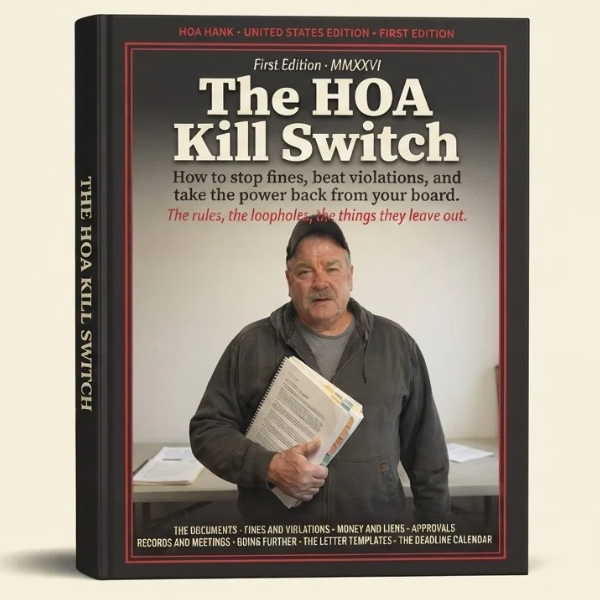
The HOA Kill Switch

First Edition, 2026 · United States Edition. Instant download, and it is yours to keep and print.

The HOA Kill Switch by HOA Hank

Ninety moves, seven parts, and the six letters that do most of the work. Written to be opened at the page you need on the day the envelope arrives.

The HOA Kill Switch First Edition · 90 Moves
  • The complete 135-page illustrated PDF, First Edition 2026
  • All 90 moves across seven parts, each ending with The Limits
  • Six letter templates you can fill in and send today
  • A glossary of the words they use against you
  • Reads on phone, tablet, laptop or e-reader — and prints clean for the binder
$47 $27
Get The HOA Kill Switch — $47 $27

Instant download · Yours forever

Visa · Mastercard · Amex · PayPal · Apple Pay
Section VII · Questions

Questions I Get Asked

Is this legal advice?

No, and I say so on page three of the book as plainly as I can say it. I am a homeowner who reads paperwork, not an attorney, and reading this does not make me your lawyer. It is general education about how associations work in the United States. Every one of the ninety moves ends with a section called The Limits, which is where I tell you exactly where my answer stops and your own documents, your own statute, or an attorney licensed in your state has to take over. Before you act on anything with money, a lien, or a deadline attached to it, read your own declaration and talk to someone licensed where you live.

Does any of it apply in my state?

Community association law is set state by state, and two houses four hours apart can have opposite answers to the same question. That is exactly why the book is built the way it is. Move 8 is finding your state statute before you do anything else, and every move afterwards tells you which part of it is machinery that works everywhere — the hierarchy of documents, the ledger, the records request, the hearing, the arithmetic — and which part you have to check locally. The single most important document in any dispute is your own recorded declaration, and that one is the same wherever you live: yours.

Your videos are free. Why would I buy the book?

Because a video answers the question one person asked, and a book has to answer the question you have at eleven at night with a letter in your hand and a deadline on it. The Kill Switch puts all ninety moves in the order things happen, so when the notice arrives you go straight to Part Three and it is all there — the cure period, the hearing, the appeal, the defenses — instead of scrubbing through videos hoping one of them covered your situation. And the six letter templates at the back are the part readers use most. They would make a terrible video.

Why is it only $27?

Because the people who need it most are the ones already looking at a balance they did not expect, and asking them for a hundred dollars to understand it would be its own kind of joke. It costs me nothing to send a file. $47 is where it sits once the launch promo ends; $27 is the launch number. One consultation about one letter costs several times this.

What format is it, and can I print it?

It is a PDF — 135 pages, First Edition 2026, illustrated, with each of the seven parts opening on its own plate. It opens on a phone, a tablet, a laptop or an e-reader, and it prints cleanly on ordinary paper if you would rather keep it in the binder Move 24 tells you to build. The letter templates were written to be printed and filled in. Delivery is instant — it arrives by email within about a minute — and the file is yours to keep.

I'm on my board. Is this a book against me?

No. A good number of readers are directors, and Part Six is honestly more useful to them than to anybody else. Moves 69, 70 and 71 are the meeting rules boards get wrong most often, and Move 79 — serving without becoming the person you replaced — was written for exactly that reader. A board that follows its own procedure is almost impossible to beat, which is the same fact from both sides of the table.

Nothing has happened to me yet. Is it too early to read this?

It is the best time, and it is also the cheapest. Move 24 is building the binder before you need it: the complete document set, the current amendments, the plat, the budget, the minutes. Owners who do that before the first letter arrives usually never get a second one. Move 89 is due diligence before you buy into an association at all — most buyers spend more time inspecting the water heater than the association they are about to join for thirty years.

HOA Hank
Wait — one thing

Less Than One Late Fee.

The whole book is $27 until midnight. That is less than most associations charge for being nine days late — for the ninety moves that keep the letters from stacking up in the first place.

Get The HOA Kill Switch — $47 $27 or see what's inside →